

How Your Nutrition May Be Perpetuating Injuries & Pain
Background
Injuries and discomfort are unfortunately not uncommon for athletes and active people. While many factors contribute to recovery and permanent elimination of pain, nutrition is critically important in healing injuries and resolving pain yet is often overlooked.
Many athletes and active people come to AP Nutrition & Training experiencing pain or a diagnosed injury that is preventing them from fully enjoying their favorite activities and reaching their goals in a sport. These setbacks are often a secondary reason for beginning a nutrition program, yet many are pleasantly surprised by the number of ways that nutrition can accelerate injury recovery and removal of daily discomfort.
Our nutrition programs address injuries and pain through individualized macro- and micronutrient intake, tailored timing, and supplement use. We also examine several individual contributing factors, such as injury progression and current staging, chronotype as it relates to sleep optimization, and chronological age.
Here are a few of the most common ways in which nutrition may be perpetuating your injuries and pain, and how our tailored nutrition programs address these areas.
Negative Energy Balance
Most injuries and pain require healing or at least strengthening of surrounding structures. These healing functions are nonessential to the body and as a result will only take place with adequate available energy. If the body does not receive as much energy (in food intake) as it is expending in a day, it will conserve energy by focusing on essential organs, such as the heart and brain, and voluntary movement it has been asked to do. All structures and especially cartilage and tendons, with poorer blood supplies, will be limited or halted in their healing capacities. On top of adequate overall energy, adequate protein, spaced deliberately throughout the day, is needed for an injury to heal. In some cases, specific strategies can allow for a slight reduction in body fat while also gaining strength and healing.
Many athletes and active individuals do not know all of the signs that their body is not getting as much energy as it is expending. Notably, appetite is often suppressed with sustained periods of inadequate energy intake, often perpetuating unmet nutrient needs. Daily signs such as a sudden drop in resting heart rate, feeling colder than expected, slow digestion and bloating, legs feeling “flat” or lacking spring, and poorer focus all point to the body’s conservation of energy, meaning that healing, non-essential, is hindered or halted.
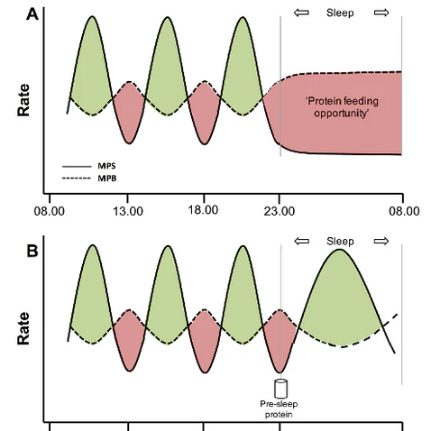 Another common challenge is uneven energy intake. Appetite is naturally suppressed at several windows of the day, including early in the morning. Longer stretches of time without food intake lead to an increase of catabolic (breakdown) hormones, meaning the body is at best not healing damaged tissues and at worst breaking them down. Notably, markers of bone breakdown increase significantly following days with a high portion of time in a negative energy balance. Furthermore, long stretches of time in a calorie deficit will often lead to poor energy, increased cravings, and excessive intake later in the day.
Right: Graph by YML Sport Science demonstrates the value of evenly spaced nutrients and protein at specific hours of the day.
Another common challenge is uneven energy intake. Appetite is naturally suppressed at several windows of the day, including early in the morning. Longer stretches of time without food intake lead to an increase of catabolic (breakdown) hormones, meaning the body is at best not healing damaged tissues and at worst breaking them down. Notably, markers of bone breakdown increase significantly following days with a high portion of time in a negative energy balance. Furthermore, long stretches of time in a calorie deficit will often lead to poor energy, increased cravings, and excessive intake later in the day.
Right: Graph by YML Sport Science demonstrates the value of evenly spaced nutrients and protein at specific hours of the day.
How we help:
Essential to AP Nutrition & Training programs is pinpointing individual nutrient needs and translating these into foods, portions, and timing.
Poor Timing
Some individuals will be meeting their energy needs for a day as a whole yet be surprised by slower healing of injuries or lingering cycles of poor energy and inflammation. On top of reaching nutrient needs, timing is essential for nutrients to serve their purpose. One of the most common challenges lies in missing out on high-impact times for calories and specifically protein. Cells are especially sensitive to protein following a workout, as well as to both protein and carbohydrate following a workout of longer duration. Protein consumed in the hour or two before falling asleep is digested and absorbed when hormones that build and repair are released, and hence directly provides material for the body to build with. Other individuals have other critical windows in their day, and missing a critical window can leave the body in a state of breakdown rather than of building.
Another common challenge is uneven energy intake. Appetite is naturally suppressed at several windows of the day, including early in the morning. Longer stretches of time without food intake lead to an increase of catabolic (breakdown) hormones, meaning the body is at best not healing damaged tissues and at worst breaking them down. Notably, markers of bone breakdown increase significantly following days with a high portion of time in a negative energy balance. Furthermore, long stretches of time in a calorie deficit will often lead to poor energy, increased cravings, and excessive intake later in the day.
Right: Graph by YML Sport Science demonstrates the value of evenly spaced nutrients and protein at specific hours of the day.
How we help:
At AP Nutrition & Training, we examine not only what your body needs but when it needs it, with practical food options, to maximize utilization of nutrients.
Inflammation Promotion
While inflammation is part of the chemical reactions that heal injuries, excessive inflammation can heighten pain while injured, inhibit muscles (furthering inflammation and pain), and linger to create discomfort after complete healing. Several foods work through specific pathways that resolve inflammation that no longer supports healing. At the same time, other foods can perpetuate inflammation. With certain categories of food, such as grains and dairy, specific food choices can promote inflammation more so than others, and individuals often have very different thresholds for what can cause them inflammation.How we help:
At AP Nutrition & Training, we consider the role that inflammation may be playing in discomfort and provide tailored recommendations for different categories of food to curb inflammation without medication.
Unused or Misused Supplements
Supplements play a critical role in injury healing and reduction in inflammation. However, many athletes and active individuals do not use supplements that specifically aid recovery of their injury. Beyond nutrients that food can offer, supplements specifically support cartilage health, tendon and ligament health, bone health, skin health, and muscle strength. Although supplements that safely aid muscle strength often align closely with sport performance products, supplements that support health of other structures in the body are often not on athletes’ radar screens. Furthermore, many athletes and active people leverage supplements when less helpful or even harmful. For instance, excessive use of caffeine and other stimulants can interfere with precise movement patterns and can cause large increases in force and power production from one workout to the next, increasing risk of irritation. On a similar note, essential amino acid supplements are commonly used yet provide little additional benefit for most individuals.How we help:
AP Nutrition & Training plans involve custom supplement recommendations, all evidence-based, and complementary supplement packages.
Conclusion
Although injuries and discomfort can plague athletes and active individuals as they challenge themselves, nutrition provides several often overlooked avenues to accelerate healing and resolution of pain. AP Nutrition & Training programs take detailed individual steps to ensure adequate energy availability, timing to enable healing, management of inflammation, and food choices relevant to the specific case.
Coming Summer 2026
A self-paced course and live Q&A sessions will be launched, providing an in-depth overview of nutrition as it relates to injury recovery and pain resolution.

Ready to take the next step towards your goals?
Connect directly with Amanda Pasko, your expert Registered Dietitian and World Champion athlete. Discover how her personalized nutrition and performance coaching can unlock your full potential and craft a science-backed, sustainable plan just for you.
References
- Ackerman KE, Holtzman B, Cooper KM, et al. Low energy availability surrogates correlate with health and performance consequences of Relative Energy Deficiency in Sport. British Journal of Sports Medicine, 2019. View on PubMed
- Papageorgiou M, Martin D, Colgan H, et al. Bone metabolic responses to low energy availability achieved by diet or exercise in active eumenorrheic women. Bone, 2018. View on PubMed
- Papageorgiou M, Elliott-Sale KJ, Parsons A, et al. Effects of reduced energy availability on bone metabolism in women and men. Bone, 2017. View on PubMed
- Trommelen J, van Loon LJC. Pre-Sleep Protein Ingestion to Improve the Skeletal Muscle Adaptive Response to Exercise Training. Nutrients, 2016. https://doi.org/10.3390/nu8120763